Solar activity and Earth's Climate
How the Sun Shapes Climate and Drives Natural Warming or Cooling?
The Sun is the primary driver of Earth’s climate. Nearly all surface energy, atmospheric circulation, and oceanic dynamics originate from solar radiation. Variations in Total Solar Irradiance (TSI), which changes by roughly 0.1% over the ~11-year solar cycle, can modulate temperature, circulation patterns, and cloud formation. These fluctuations are associated with the Sun’s magnetic activity and sunspots, which also influence cosmic ray flux and atmospheric ionization, indirectly affecting climate.
Total Solar Irradiance (TSI)
Total Solar Irradiance is the measure of all solar energy reaching the top of Earth’s atmosphere. It represents the Sun’s direct energy input into the climate system and determines how much heat the planet receives and retains.
Although TSI varies only about 0.1% over the 11-year solar cycle, even such small fluctuations can alter the energy balance between incoming solar radiation and outgoing infrared heat. Sustained changes over decades or centuries can therefore influence surface temperatures, ocean heat storage, and atmospheric circulation.
Periods of higher irradiance generally coincide with warmer climatic phases, while extended reductions in TSI, such as during the Maunder Minimum (1645–1715), have been linked to cooler conditions in the Northern Hemisphere.
Further reading:
Gray et al., Reviews of Geophysics, 2010 - "Solar Influences on Climate"
Haigh, Living Reviews in Solar Physics, 2007, "The Sun and the Earth's Climate"

Lorem ipsum dolor sit amet, consectetur adipiscing elit. Nulla euismod condimentum felis vitae efficitur. Sed vel dictum quam, at blandit leo.
Solar cycles and Sunspots
Solar activity rises and falls in an approximately 11-year cycle, first discovered by Samuel Heinrich Schwabe in 1843 while observing sunspots. Later, Rudolf Wolf reconstructed historical sunspot records back to 1755, creating the Wolf Sunspot Index, still used today to track long-term solar variability.
Sunspots are cooler, darker regions on the Sun’s surface caused by concentrated magnetic fields. Their number, size, and distribution serve as a visible measure of solar activity, with more sunspots indicating stronger magnetic activity and slightly higher solar energy output.
Impact on Earth’s climate:
Temperature variations: High sunspot periods slightly increase total solar irradiance (TSI), contributing to warmer phases, while prolonged low activity (e.g., Maunder Minimum) coincides with cooling events like the Little Ice Age.
Atmospheric effects: UV fluctuations linked to sunspot cycles alter stratospheric heating and jet stream patterns, shifting weather and climate zones.
Indirect effects: Changes in the solar wind modify cosmic ray flux, potentially influencing cloud formation and surface albedo, which reinforce warming or cooling trends.
Oceanic modulation: Small but persistent solar variations affect ocean heat content and currents, redistributing energy and amplifying climate impacts over decades.
Sunspots are therefore a key observable fingerprint of the Sun’s natural influence on Earth’s climate, providing insight into historical and modern patterns of warming and cooling.
Sunspots - courtesy of NASA/NOAA
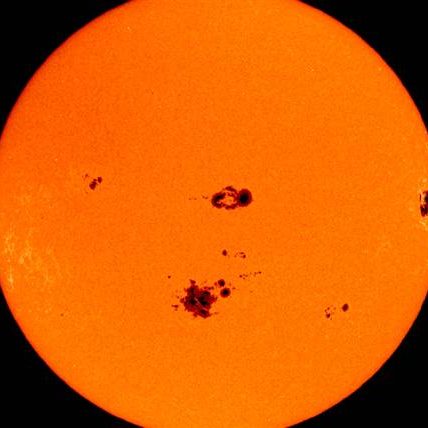
Lorem ipsum dolor sit amet, consectetur adipiscing elit. Nulla euismod condimentum felis vitae efficitur. Sed vel dictum quam, at blandit leo.
Solar Magnetic Activity and Cosmic Rays
The Sun is surrounded by a vast magnetic field that extends far beyond the planets. This field constantly changes with the solar cycle, becoming stronger during high activity (many sunspots and flares) and weaker during quiet periods.
When solar magnetic activity is strong, the enhanced solar wind and magnetic shielding reduce the number of galactic cosmic rays—high-energy particles originating outside the Solar System—reaching Earth’s atmosphere. During low solar activity, this shield weakens, allowing more cosmic rays to penetrate the atmosphere.
Cosmic rays can influence cloud microphysics by creating ions that act as condensation nuclei, around which water droplets form. Increased cosmic-ray flux may therefore lead to greater low-cloud coverage, reflecting more sunlight and promoting surface cooling. Conversely, fewer cosmic rays during solar maxima can result in reduced cloudiness and slightly warmer surface conditions.
This proposed relationship—known as the Svensmark effect—remains under active scientific study, with experimental and satellite evidence suggesting that cosmic-ray variability may contribute to regional and short-term climate modulation.
Further reading:
Svensmark et al., Scientific Reports, 2021 - "Atmospheric ionization and cloud radiative forcing"
Lorem ipsum dolor sit amet, consectetur adipiscing elit. Nulla euismod condimentum felis vitae efficitur. Sed vel dictum quam, at blandit leo.