Milankovitch Cycles
Earth’s climate is influenced not only by daily weather but also by slow, long-term changes in its orbit and tilt, known as Milankovitch cycles — named after the Serbian scientist Milutin Milanković, who first described them in the early 20th century. These cycles determine how sunlight (solar energy) reaches Earth — how much, where, and when it arrives — and thus shape the planet’s long-term patterns of temperature, ice cover, rainfall, and extreme weather.
A key driver behind these cycles lies in the gravitational pull of the giant planets Jupiter and Saturn. Their immense mass subtly pulls on Earth’s orbit, causing it to stretch or wobble over tens of thousands of years. These distant giants act as the "cosmic metronomes" of the Milankovitch cycles, setting the rhythm for changes in Earth’s orbital shape, axial tilt, and precession.
The three main cycles are:
- Eccentricity – the shape of Earth’s orbit (more circular or more elongated)
- Obliquity – the tilt of Earth’s axis
- Precession – the wobble of Earth’s axis and the timing of seasons
These cycles act as a climate baseline, defining the long-term conditions under which weather develops. They don’t directly create storms, floods, or heatwaves — those arise from short-term atmospheric processes — but they control the background energy balance of the Earth by determining how sunlight is distributed across the planet. As the cycles shift, they gradually reshape temperature contrasts between the poles and the equator, influence the extent of ice and snow, and affect how heat and moisture circulate through the oceans and atmosphere.
In essence, the Milankovitch cycles set the “climate mode” of the planet — whether it leans toward a cooler, wetter, or stormier state. For example, a stronger axial tilt intensifies seasonal contrasts, producing hotter summers and colder winters that can fuel heatwaves or snowstorms. Similarly, even small changes in sunlight reaching the oceans can alter major current systems like the Gulf Stream, shifting storm paths and affecting their intensity.
Currently, all three cycles overlap in specific phases, which amplifies their combined effect on the climate system. In addition, natural events and processes such as volcanic eruptions, earthquakes and tectonic uplift, underground coal or peat fires, changes in ocean currents, solar radiation fluctuations, large-scale wildfires, and variations in sea ice or glacier cover can add energy, release heat or particles, or disturb ocean–atmosphere balance. These factors together can intensify extreme events like storms, floods, droughts, and heatwaves on top of the orbital baseline.
1. Eccentricity (Shape of the Orbit)
Credit: NASA/Jet Propulsion Laboratory - California Institute of Technology (Caltech)
Please click the image to visit the NASA website for animation.
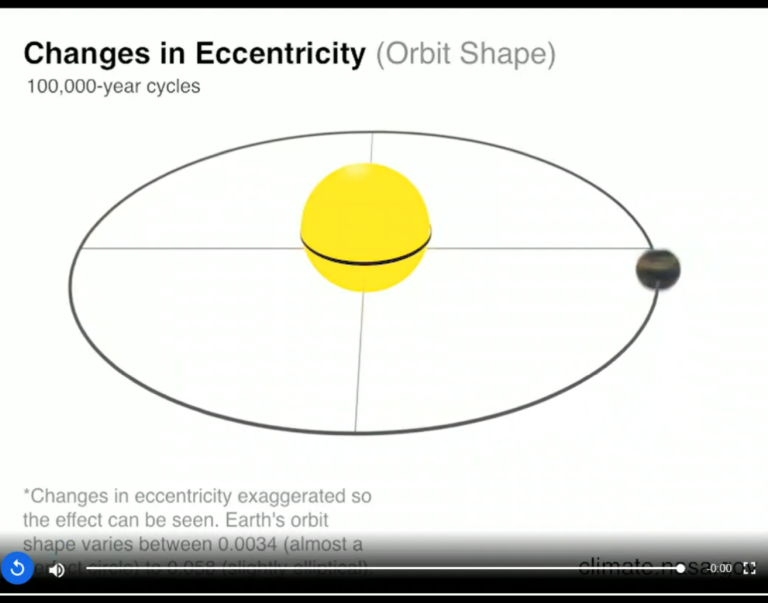
Eccentricity measures how stretched Earth’s orbit is. A perfectly circular orbit has low eccentricity; an elongated orbit has high eccentricity. In an elliptical orbit, Earth is closer to the Sun at some points (perihelion) and farther at others (aphelion), changing seasonal solar energy. Jupiter and Saturn, through their gravitational pull, actively influence Earth’s eccentricity over long timescales, shaping these variations in solar exposure.
High eccentricity → larger seasonal variation in sunlight.
Low eccentricity → smaller variation, seasons receive sunlight more evenly.
Current state: Nearly circular (~0.0167) -> seasonal differences caused by orbit shape are minimal.
Impact on today’s climate:
Earth’s nearly circular orbit keeps seasonal sunlight relatively balanced, moderating extremes in temperature between seasons. This helps set the baseline for climate patterns, influencing long-term trends in Northern Hemisphere summers, ice sheet stability, and monsoon strength. Over long timescales, the slow gravitational effects of Jupiter and Saturn also slightly alter eccentricity, subtly shaping these seasonal patterns.
Monsoons: Stronger summer sunlight during high-eccentricity periods increased rainfall in South Asia and Africa.
Northern Hemisphere summers: Eccentricity influenced summer warmth, shaping long-term climate trends.
2. Obliquity (Axial Tilt)
Credit: NASA/Jet Propulsion Laboratory - California Institute of Technology (Caltech)
Please click the image to visit the NASA website for animation.
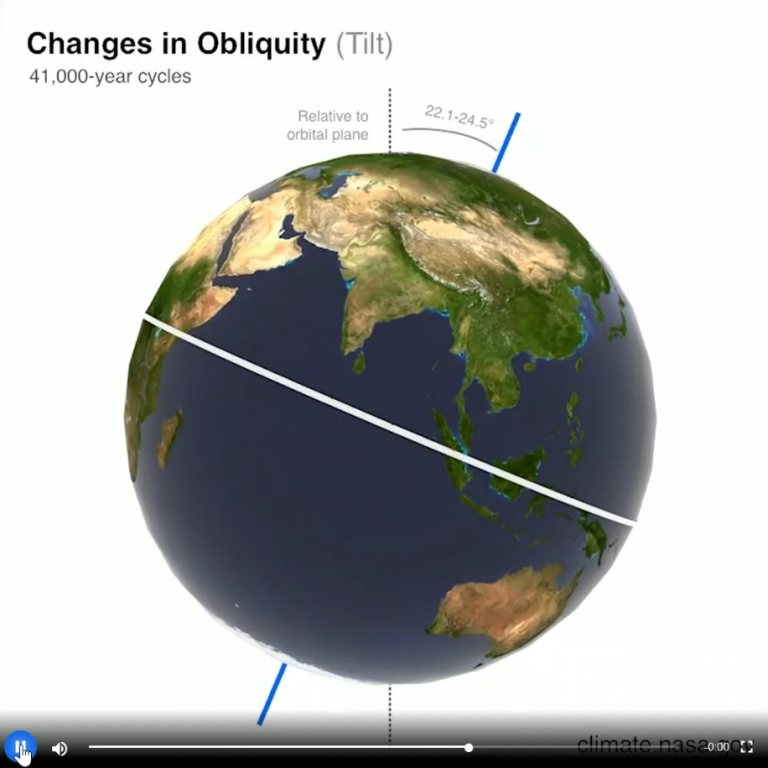
Obliquity is the tilt of Earth’s axis relative to its orbital plane, varying between ~22.1° and 24.5° over ~41,000 years. Tilt changes the angle of sunlight at different latitudes, especially high latitudes, which affects the seasonal growth and melting of ice and snow. This in turn influences albedo: when more ice melts in summer, the surface reflects less sunlight → lower albedo → more solar energy absorbed; when ice persists, albedo remains higher → more sunlight reflected → moderating warming.
High-latitude effects (60°–90° N/S):
Higher tilt → Sun rises higher in summer → more solar energy → more ice melts → lower albedo; winters receive less sunlight → colder winters.
Lower tilt → Sun stays lower in summer → less ice melts → higher albedo; seasonal contrasts milder.
Mid-latitude effects (30°–60° N/S):
Seasonal differences remain noticeable → less extreme than at high latitudes.
Current state:
~23.4°, slowly decreasing.
Effect of today’s moderate tilt (~23.4°):
High-latitude summers (60°–90° N): Moderate tilt → Sun rises moderately high → enough solar energy to melt some ice → seasonal reduction of Arctic sea ice, but less than during periods of maximum tilt → albedo decreases slightly → more solar energy absorbed.
High-latitude winters: Sunlight is weak → most ice refreezes → seasonal cycle of ice maintained → albedo increases → moderates winter warming.
Mid-latitudes (30°–60° N/S): Seasonal contrasts remain noticeable → drive regular patterns of storms, snowmelt, and rainfall.
Overall: Today’s moderate tilt produces balanced seasonal conditions, forming the baseline climate on which short-term weather events act.
3. Precession (Earth's Wobble)
Credit: NASA/Jet Propulsion Laboratory - California Institute of Technology (Caltech)
Please click the image to visit the NASA website for animation.
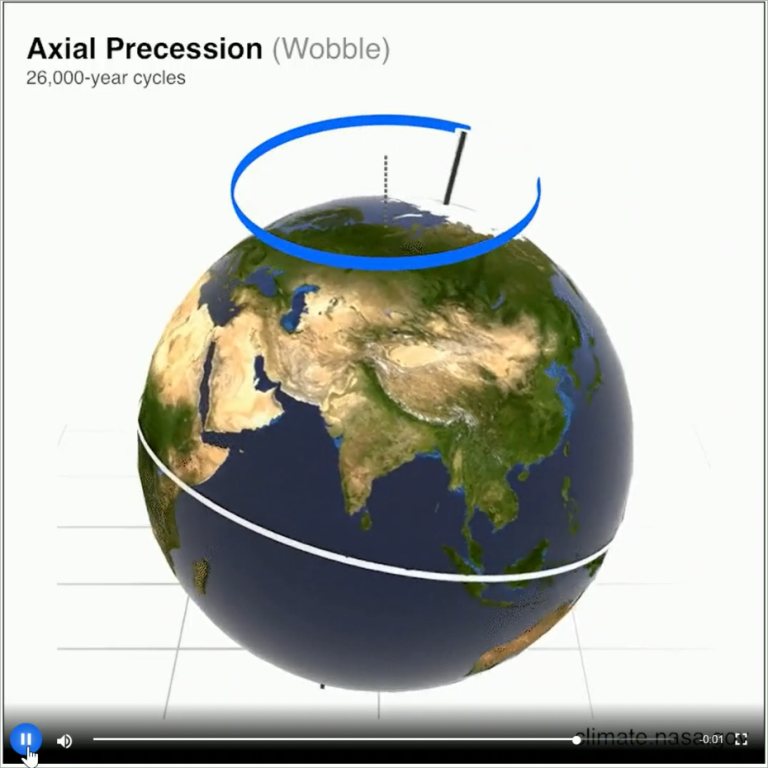
Precession is the slow wobble of Earth’s rotational axis combined with the rotation of its orbital ellipse over ~19,000–23,000 years → shifts the timing of the seasons relative to Earth’s distance from the Sun (aphelion: farthest; perihelion: closest).
Earth’s axis slowly wobbles over thousands of years. About 4,700 years ago, it pointed near Thuban (α Draconis), today it points near Polaris (the North Star), and in roughly 13,000 years it will point near Vega. This wobble changes the timing of the seasons: in ~13,000 years, Northern Hemisphere summer will occur near perihelion (January), making summers hotter.
Current state and effect:
Northern Hemisphere summer occurs near aphelion, so high-latitude regions receive slightly weaker sunlight → modestly reduced ice melt → slightly moderates high-latitude warming.
High-latitude winters → most ice refreeze → maintain the seasonal ice cycle.
Mid-latitudes (30°–60° N/S) → seasonal contrasts are moderately softened today → milder summer–winter differences, which can indirectly influence storm intensity, precipitation, and snowmelt.
Ocean influence: slightly cooler summers → modest baseline moderation of ocean heating → contributes to long-term energy distribution.
How sunlight falls:
Summer at perihelion → Earth closer to Sun → stronger sunlight → hotter summers.
Summer at aphelion (today) → Earth farther from Sun → weaker sunlight → cooler summers.
Precession shifts the timing of sunlight distribution, affecting when and how strongly each hemisphere experiences summer and winter, modulating seasonal contrasts, particularly at mid-latitudes.
Effect on today’s climate:
Modulates baseline seasonal contrasts, especially at mid-latitudes.
Influences ice melt, albedo, ocean energy, storm patterns, and precipitation on long timescales.
Operates over millennia, establishing the climate baseline upon which short-term weather events occur.
Mechanism summary:
Precession → shifts timing of seasons relative to Sun → modulates seasonal contrasts (particularly mid-latitudes) → affects ice, albedo, ocean energy, storms, and rainfall → sets today’s long-term climate baseline.
Further reading
Summary of Milankovitch cycles and their importance in ice age timing and climate variation.
The study investigates the relationship between Earth's orbital cycles (Milankovitch forcing) and the cycles of major glaciation, focusing on how linear responses might explain the observed climate patterns, particularly the 100-kyr cycle which is too large to be directly caused by the small changes in insolation from eccentricity. The authors use a combination of proxy data (from deep-sea cores and ice cores) and modeling to analyze how these orbital variations, despite their small direct impact, could trigger the long-term glacial cycles. Fundamental paper analyzing paleoclimate data showing spectral peaks at Milankovitch frequencies, supporting the cycles' role in climate variation.
Provides interpretation of Milankovitch cycles in geological records confirming orbital forcing effects on sedimentation and climate
Explores the climate response mechanisms related to obliquity and precession and transitions in glacial cycles.