Earth’s Geomagnetic Field
Earth’s geomagnetic field arises from the geodynamo — the convection of electrically conductive molten iron and nickel within the outer core. These motions, driven by heat loss from the inner core and modulated by Earth’s rotation, generate electric currents that sustain the magnetic field.
Spatial extent and protective function:
The field extends outward into space as the magnetosphere, shielding the planet from solar and cosmic particle fluxes and regulating how high-energy particles interact with the upper atmosphere.
Dynamic nature:
The geomagnetic field evolves continuously as the outer core’s flow patterns reorganize, resulting in slow but measurable variations in both field strength and pole position.
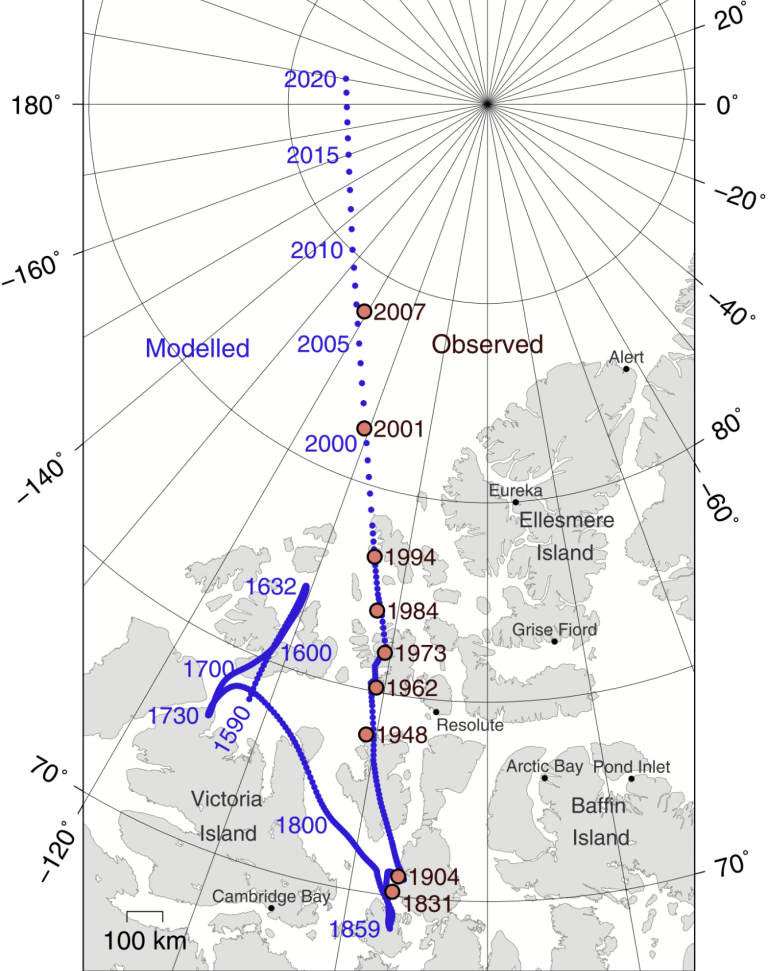
Positions of North Magnetic Pole of the Earth. Poles shown are dip poles, defined as positions where the direction of the magnetic field is vertical. Red circles mark magnetic north pole positions as determined by direct observation, blue circles mark positions modelled using the GUFM model (1590–1890) and the IGRF-12 model (1900–2020) in 1 year increments. For the years 1890–1900, a smooth interpolation between the two models was performed. The modelled locations after 2015 are projections.
Credit:Wikimedia Commons - Magnetic North Pole Positions 2015 mk.svg
Further reading: Pole wandering - Encyclopedia Britannica.
North Magnetic Pole Drift
The North Magnetic Pole is moving from northern Canada toward Siberia, crossing the Arctic Ocean.
Drift acceleration:
1900: ~10–15 km/year
Mid-20th century: 30–40 km/year
1990s–present: 50–60 km/year
The acceleration is caused by changes in the flow of molten metal beneath the Arctic, specifically in the magnetic flux lobes between the Canadian and Siberian regions.
Further reading:
Impact on Earth Systems
Climate change
Pole drift linked statistically and mechanistically to temperature trends via cosmic rays and UV solar effect
Ocean dynamics
Ocean-induced, core-driven magnetic signals reveal feedbacks with pole location and climate patterns
Cosmic radiation
Pole drift raises altitude of cosmic ray penetration; impacts atmospheric heating, satellite stability