Earth from space: Credit: NASA
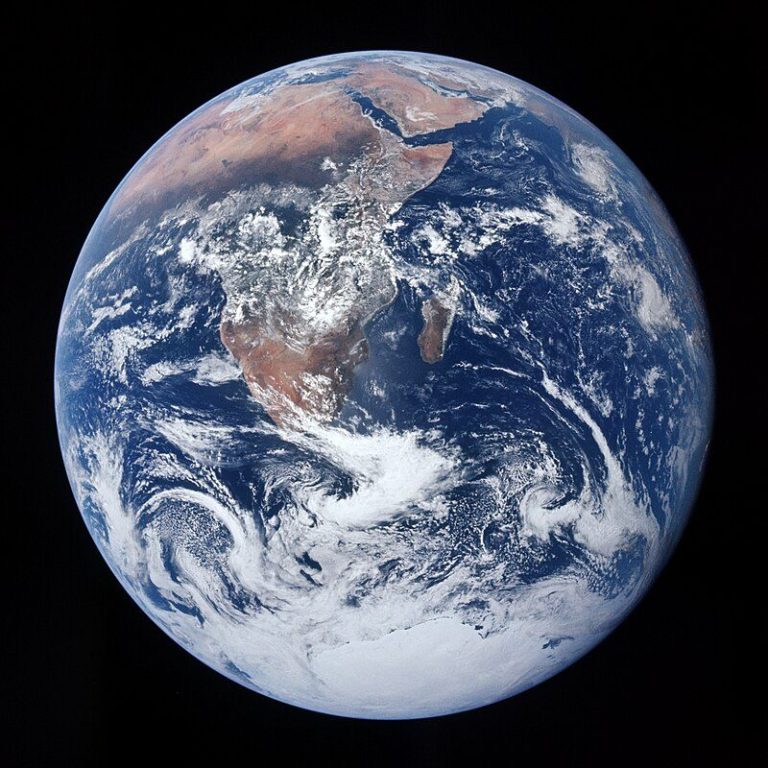
EARTH
Earth is a planet of extraordinary complexity, shaped over more than 4 billion years. Its climate reflects the intricate interplay of atmosphere, oceans, land, ice, and life, and has been repeatedly influenced by catastrophic events—asteroid impacts, massive volcanic eruptions, abrupt ocean circulation shifts, and glaciations—that altered both climate and the course of life. Warming and cooling phases have been natural and recurrent, driven by orbital cycles, tectonic activity, ocean dynamics, and variations in solar output.
At its core, Earth’s climate is powered by the Sun. Variations in solar radiation and activity drive the energy that sustains weather systems and long-term climate patterns. Winds, ocean currents, and the distribution of land and sea redistribute this energy, creating regional climates and dynamic weather phenomena. Clouds, aerosols, and greenhouse gases act as regulators, while biological systems—from microbes to forests—interact with physical processes, shaping carbon and water cycles. Extreme events such as storms, droughts, and wildfires emerge from these coupled processes, illustrating the nonlinear and chaotic nature of climate.
Understanding Earth’s climate requires engagement across multiple scientific disciplines: climatology, oceanography, geology, solar physics, glaciology, ecology, hydrology, atmospheric chemistry, paleobiology, and more. Predictive models provide critical insights but cannot fully capture the inherent complexity, particularly the emergence of extreme events. Superimposed on this natural variability, human activities influence atmospheric composition, land use, and biogeochemical cycles, though to a lesser extent than the broader natural dynamics.
LUX VERITAS aims to synthesize these interconnected topics, conveying both the complexity of the climate system and the multidisciplinary approaches required to study it. The project underscores the limitations of current discourse, which often focuses narrowly on CO₂ emissions while overlooking broader natural dynamics. By highlighting these constraints and the inherent unpredictability of extreme events, LUX VERITAS emphasizes the necessity of integrating knowledge across disciplines and appreciating Earth’s climate in its full complexity.